Qantas QF72: The A330 ADIRU Failure That Pitched a Jet Into a Dive
One faulty air data unit. One unfiltered stream of bad angle-of-attack values. Two minutes later, 303 passengers were hitting the ceiling of an A330 cruising at 37,000 ft.
At 0440 UTC on 7 October 2008, Qantas Flight 72 was in the cruise, Singapore to Perth, 154 km west of Learmonth, Western Australia. Autopilot engaged. Nothing unusual on the ECAM. Then the autopilot disconnected, and the flight deck lit up with warnings that did not agree with each other.
Two minutes later the aircraft pitched down without any pilot input, and kept going.
The short answer: the Australian Transport Safety Bureau (ATSB, report AO-2008-070) found that one of the three air data inertial reference units (ADIRU 1) sent intermittent, wrong angle-of-attack (AOA) values. A limitation in the A330/A340 flight control primary computer (FCPC) AOA algorithm could not handle spikes arriving 1.2 seconds apart, so the computer commanded a pitch-down. The failure mode was extremely rare: three known occurrences in over 128 million operating hours of the unit.
The flight: Qantas QF72, A330-303 VH-QPA
VH-QPA was an Airbus A330-303 operating Singapore to Perth with three flight crew, nine cabin crew and 303 passengers. The aircraft was at 37,000 ft in cruise when the occurrence began. It ended with a diversion and landing at Learmonth, and more than 100 people on board injured, a number of them seriously (ATSB AO-2008-070).
Minute by minute
- 0440:26 UTC - ADIRU 1 begins providing incorrect data to other aircraft systems.
- 0440:28 - Autopilot 1 disconnects. The crew now has the aircraft in manual control with conflicting indications.
- About 0440:31 - the IR function of ADIRU 1 indicates a failure.
- 0440:34 - first of many AOA 1 spikes recorded (+50.6 degrees).
- 0442:27 - the flight control computers command a sudden pitch-down. The aircraft loses about 650 ft before the crew recovers.
- A few minutes later - a second pitch-down occurs; the crew then diverts to Learmonth.
Note the gap: roughly two minutes passed between the start of the ADIRU fault and the first pitch-down command. The aircraft behaved normally enough that nothing forced the crew to a conclusion. Then it did not.
How the A330 uses air data: why one bad unit can move the nose
On the A330, three ADIRUs each provide air data (ADR) and inertial reference (IR) information. In normal law, the flight control primary computers (FCPCs) use angle of attack, airspeed and attitude to run the protections: alpha protection, high-speed protection, load factor limitation. That is what makes the aircraft so forgiving, and also why it needs clean data.
The AOA processing in the FCPC averaged AOA 1 and AOA 2. If the two values disagreed, the computer held the last value from 1.2 seconds earlier, to filter out brief spikes. That logic worked for isolated spikes. It could not handle repeated spikes from one ADIRU arriving at about 1.2 second intervals: the memorised value was itself a spike, and the computer treated it as real, triggering the high angle-of-attack protection and a nose-down command.
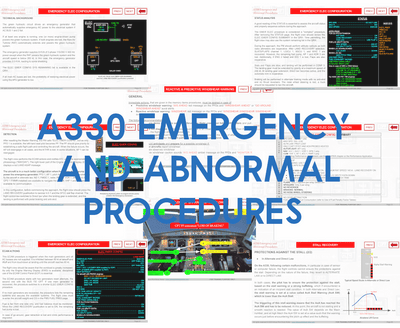
This is the difference between memorising "ADR disagree" as an ECAM line and understanding the architecture behind it. The same data-voting logic sits behind every unreliable airspeed and ADR fault you will meet in the simulator. The A330 Emergency and Abnormal Procedures study notes walk through those procedures one by one, and our article on how Airbus fly-by-wire works covers the control-law background.
Why did ADIRU 1 fail? The ATSB's explanation
The ATSB concluded that a rare trigger combined with a hardware weakness in the ADIRU's processor most likely produced the spikes. Each intermittent spike was probably generated when the central processor unit (CPU) module of the LTN-101 ADIRU combined the data value of one parameter with the label of another. Three known occasions of this failure mode in over 128 million hours of unit operation.
Crucially, the report found that the system safety assessment, testing and simulation during design and certification had not identified the limitation in the FCPC AOA algorithm. Nobody had missed a checklist item. The scenario was simply outside what the design had considered.
Threat and Error Management analysis
| Element | What happened | Countermeasure |
|---|---|---|
| Latent threat | Rare ADIRU CPU failure mode; FCPC AOA logic that could not handle 1.2 s spikes | None available to the crew; this was a design-level threat |
| Threat | Conflicting warnings and indications in cruise with no obvious cause | Manual control, systematic assessment of the failing air data source |
| Undesired aircraft state | Uncommanded pitch-down at 37,000 ft with unrestrained occupants | Manual recovery by the crew; seat belt discipline in cruise |
| Recovery | Diversion and landing at Learmonth | Controllability assessment and a divert decision with a degraded aircraft |
The Swiss cheese: HFACS layers
- Unsafe acts: the report did not attribute the upset to crew error. The crew faced a failure that no procedure had anticipated.
- Preconditions: cruise phase, many occupants out of their seats, a failure mode that the crew could not recognise from the first indications.
- Unsafe supervision: none identified in the sources reviewed for this article.
- Organisational influences (design and certification): the design and safety assessment process did not identify the FCPC algorithm limitation, and the ADIRU failure mode was not known to the industry.
What the investigators concluded
The ATSB issued its final report, 313 pages, on 19 December 2011. It found the combination of an ADIRU failure mode and a limitation in the A330/A340 FCPC AOA algorithm to be the cause. The report notes that the FCPC algorithm was very effective in handling the failure scenarios it was designed for, but could not correctly manage multiple spikes in AOA 1 or AOA 2 that were 1.2 seconds apart.
With hindsight: what has changed since
- EASA issued an emergency airworthiness directive in January 2009 on A330/A340 aircraft fitted with the affected ADIRUs.
- Airbus redesigned the AOA processing. The revised logic still averages AOA 1 and AOA 2 but drops the 1.2-second memorisation period, adds consistency checks across all three AOA values, and can reject an air data source that shows overall oscillation. The ATSB closed its safety issue on 19 December 2011 (AO-2008-070-NSA-050).
- Airbus said it would apply lessons from the occurrence to the types of incorrect data patterns considered in future design work.
Lessons for today's line pilot
- Fly the aircraft first. When the autopilot drops out and the messages do not agree, stabilise the flight path before diagnosing.
- Do not assume the protection logic is right. Protections depend on data. Bad data means a protection can act when it should not.
- Identify the source. Work out which air data source is lying and take it out of the loop using the published procedure; knowing your ADR logic is part of that.
- Keep the seat belts on in the cruise. A sudden pitch-down at 37,000 ft injured over a hundred people on board; unrestrained occupants are the most exposed.
- A problem that goes quiet is not solved. Two minutes of apparently normal behaviour preceded the first pitch-down.
- Treat the cabin as part of the system. Brief the cabin crew early when you have a degraded aircraft.
- Know the architecture, not just the ECAM. The pilot who knows how the computers vote on air data reads the situation faster.
These lessons only help if the procedures are automatic when it counts. If you fly the A330, our A330 Emergency and Abnormal Procedures study notes cover unreliable air data, ADR faults and flight control degradation in plain language, and the A330 Normal Procedures and Checklists complete your checkride preparation. You can browse all our A330 study materials here.
FAQ
What caused Qantas flight QF72 to dive?
A faulty ADIRU (ADIRU 1) sent spiking angle-of-attack data, and a limitation in the FCPC algorithm that processes it led the computers to command a pitch-down (ATSB AO-2008-070).
Was the QF72 pilot error?
The ATSB did not attribute the upset to crew error. It found a design limitation combined with a rare hardware failure mode.
How many people were injured on QF72?
More than 100 of the 315 people on board were injured, a number seriously.
Can an A330 still do this today?
Airbus redesigned the AOA processing, and the ATSB closed the safety issue in December 2011. The failure mode of the ADIRU itself was also addressed by an airworthiness directive in 2009.
What is an ADIRU?
The air data inertial reference unit combines the air data (ADR) and inertial reference (IR) functions that feed flight controls, displays and autoflight. The A330 has three.
Related reading
- How does the A320's fly-by-wire system work?
- Managing Non-Normal Situations: a pilot's guide
- Mastering Threat and Error Management in Aviation
Sources
- ATSB, In-flight upset, Airbus A330-303, VH-QPA, 154 km west of Learmonth, Western Australia, 7 October 2008, Aviation Occurrence Investigation AO-2008-070, final report, 19 December 2011: atsb.gov.au/investigations/ao-2008-070
- ATSB safety issue pages for AO-2008-070 (AOA algorithm redesign, NSA-050)
- Secondary coverage used to cross-check figures: Flightglobal, The Register, Aviation Week, Wikipedia (Qantas Flight 72).
Featured photo: Airbus A330-303 'VH-QPA' QANTAS (the QF72 aircraft) by Hawkeye UK, via Wikimedia Commons, licensed under CC BY-SA 2.0.
Captain Phil
Airline Captain and founder of Airline Pilot Study Notes
Study notes for the A330
Written by an airline captain · Instant digital access after purchase · Secure checkout