Boeing 737NG Type Rating: The Complete Preparation Guide (2026)
You have a place on a 737NG type rating course. Or you are about to pay for one yourself. Either way, you want to know what is coming, how much it really costs, and how to arrive on day one already ahead of the syllabus.
I fly the Boeing 737NG as a Captain, and I have watched many First Officers go through the type rating, base training and line training. Some arrive stressed and spend six weeks catching up. Others arrive prepared and actually enjoy the course. This guide explains what makes the difference.
Looking for a general overview of type ratings on every aircraft? Read our Type Rating: Complete Guide for Airline Pilots (2026). This article focuses only on the 737NG.

What is a 737NG type rating?
The 737 Next Generation (NG) covers the 737-600, -700, -800, -900 and -900ER. These are the aircraft with CFM56-7B engines, six LCD display units and the FMC-based automation that entered service in the late 1990s. The 737NG is still one of the most widespread airliners in the world, which is why the rating is so valuable on a CV.
One point that confuses many candidates: the 737 Classic, NG and MAX are not three separate type ratings. Under both the FAA and EASA systems they belong to the same 737 type rating family, and moving from one variant to another is done through differences training, not a new full course. In practice, most pilots today start on the NG or the MAX, and the NG is still the reference variant for many training organisations.
How the 737NG type rating course is structured
Every training organisation has its own syllabus, but an EASA initial 737NG course follows the same logic everywhere. A typical course lasts around six weeks, including rest days.
| Phase | What you do | Typical volume |
|---|---|---|
| 1. Ground school (CBT + classroom) | Aircraft systems, limitations, normal and non-normal procedures, performance | About 35 hours of CBT and 50 hours of classroom |
| 2. Technical exam | Multiple-choice theoretical exam on the aircraft (EASA pass mark: 75%) | One exam, end of ground school |
| 3. Simulator training | Fixed-base and full flight simulator sessions: normal operations, engine failures, non-normals, approaches, go-arounds | Around 40 to 45 hours |
| 4. Skill test | Final check ride in the full flight simulator with an examiner | One session |
| 5. Base training (or ZFTT) | Take-offs and landings in the real aircraft, or in the simulator for eligible pilots | Usually six take-offs and landings for a first type |
| 6. Line training (LIFUS) | Commercial flights with a training captain, ending with a line check | Set by the airline |
Prerequisites for a first EASA type rating: a valid multi-engine instrument rating, an MCC course, at least 70 hours as pilot-in-command, and advanced UPRT. On the FAA side, the 737 type rating is usually added to an ATP certificate, and first-time jet pilots also need the ATP-CTP course. The FAA check ride includes an oral exam, which many European pilots find more demanding than the multiple-choice format.
About ZFTT: experienced pilots can sometimes complete a Zero Flight Time Training course, where the base training is replaced by six take-offs and landings in the full flight simulator, done within 21 days of the skill test. The first four take-offs and landings on the line are then flown under the supervision of a type rating instructor.
How much does a 737NG type rating cost?
This is the question I am asked most often, and the honest answer is: it depends heavily on who pays and where you train. Here are the typical ranges published by training organisations in 2026.
| Route | Typical cost | What to check |
|---|---|---|
| Self-funded, Europe (EASA) | About €15,000 to €34,000 | Is base training included? Many low prices exclude it. |
| Self-funded, United States (FAA) | About $16,000 to $36,000 | Add $3,500 to $5,500 for ATP-CTP if it is your first jet type. |
| Airline-sponsored | No upfront cost | Usually a training bond of 1 to 3 years, or salary deductions. |
The hidden costs are where budgets explode:
- Base training billed separately from the simulator course.
- Accommodation and travel for six weeks near the simulator centre.
- MCC or UPRT if you have not completed them yet.
- Licence issue fees from your authority.
- Extra simulator sessions or a retest if a check does not go well, which can cost several thousand euros.
That last point is the strongest argument for preparing seriously before the course starts. An extra simulator session usually costs far more than any study material.
How to prepare before day one: a 6-week plan
The type rating moves fast. Ground school covers in a few weeks what an airline expects you to know for years. Pilots who struggle are rarely bad pilots. They are pilots who discover the systems during the course instead of reviewing them.
Here is the plan I recommend to First Officers who ask me how to get ready.
Weeks 1 and 2: aircraft systems
Start with the systems that drive most non-normal procedures: electrical, hydraulics, fuel, bleed air and pressurisation, flight controls, landing gear and brakes. Do not try to memorise every switch. Understand the logic: what powers what, what happens when a source fails, and which indications you will see.
Week 3: automatic flight and the FMC
The autopilot flight director system, MCP modes, autothrottle, LNAV and VNAV are where most simulator time is lost. Learn the mode logic and the FMC pages before the course. In the simulator, you want to spend your energy flying, not searching for a CDU page.
Week 4: limitations and memory items
Limitations and recall items must be known perfectly. Write them out from memory every day until they are automatic. Use the exact version from your training organisation or airline, because memory items and some limitations depend on the operator documentation.
Week 5: normal procedures and flows
Learn the cockpit preparation flow, the before-start flow and the after-take-off flow until you can do them with your eyes closed. A clean flow in the first simulator session gives your instructor immediate confidence.
Week 6: question practice and review
Spend the last week testing yourself. Practice questions show you quickly which systems you think you know but do not. Thirty to forty-five minutes a day is enough if you do it every day.
This is exactly why I built 737ng.com: an online 737NG question bank organised by system, so you can drill the technical exam topics on your phone or computer and see your weak areas immediately. If you prefer working offline, our B737 NG Type Rating Question Bank covers the same exam preparation in a downloadable format.

Line training on the 737NG: what to expect
Passing the skill test is not the end. Line training (LIFUS) is where you learn to operate the aircraft in the real world, with a training captain next to you and real passengers behind you. The number of sectors depends on the airline and on your experience, and it ends with a line check.
From the left seat, here is what I see most often in new 737NG First Officers:
- The pace of turnarounds. In the simulator, nobody is waiting for the loadsheet. On the line, the FMC preparation, the performance calculation and the briefing must be done quickly and correctly. Practise your FMC setup until it is routine.
- Real ATC. Re-clearances, speed restrictions and runway changes arrive at the worst moment. Anticipate and keep the automation one step ahead.
- Energy management. The 737NG does not slow down and go down easily at the same time. Learn to plan your descent early and to use the speedbrake and gear sensibly.
- Communication with the captain. A training captain wants to see you speak up, call deviations and share your plan. Silence is the worst signal you can send.
The good news: everything you studied before the course pays off a second time here. Pilots who know the systems well have more mental capacity left for the operation itself.
The 737NG FCOM and other documents you need
Your main reference is the Flight Crew Operations Manual (FCOM). On the 737NG it is split into two volumes:
- FCOM Volume 1: limitations, normal procedures, supplementary procedures and performance.
- FCOM Volume 2: aircraft systems, chapter by chapter.
You will also use the QRH (Quick Reference Handbook) for non-normal checklists, and the FCTM (Flight Crew Training Manual), which explains how Boeing recommends flying the aircraft. The FCTM is underrated: read it before the simulator phase.
One warning: each airline issues its own customised FCOM, and old versions circulate online. Always study from the revision provided by your training organisation or airline. To make Volume 2 easier to digest, our B737 NG Systems Study Notes summarise each system in a structured, exam-oriented format, designed to be read alongside your official documentation, not instead of it.
Frequently asked questions
How long does a 737NG type rating take?
The course itself usually takes around six weeks, including rest days. Add base training and line training, and most pilots need two to four months between the first day of ground school and their release to the line.
How much is a 737 type rating?
Self-funded, expect roughly €15,000 to €34,000 in Europe and $16,000 to $36,000 in the United States in 2026. Check whether base training, accommodation and ATP-CTP are included before comparing prices.
Can I fly the 737 MAX with a 737NG type rating?
The NG and the MAX belong to the same 737 type rating family, but you need differences training before flying the MAX. Since the MAX returned to service, this training includes specific simulator elements in addition to computer-based training.
What is the pass mark for the 737NG technical exam?
Under EASA rules, the theoretical exam is multiple-choice with a pass mark of 75%. Under the FAA system, knowledge is tested through an oral exam with the examiner. Regular practice with questions such as those on 737ng.com is the most efficient way to prepare for both.
How long is a 737NG type rating valid?
An EASA type rating is valid for 12 months and is revalidated through a proficiency check. Airline pilots renew it as part of their recurrent training.
Should I study before the course starts?
Yes. It is the single best investment you can make. Arriving with the systems, limitations and flows already reviewed turns a stressful course into a manageable one, and protects you against the cost of extra simulator sessions.
Final advice from the left seat
The 737NG is a wonderful aircraft to fly, honest and robust, and the type rating is the door to a long career on one of the most common airliners in the world. Treat the course as the final exam, not the first lesson. Start studying now, test yourself every day, and arrive on day one ready to fly rather than ready to learn.
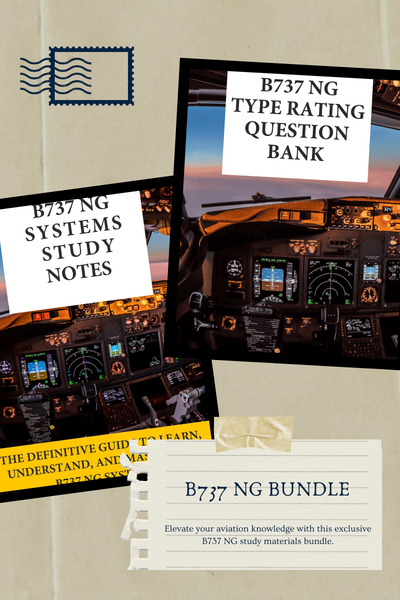
If you want a complete preparation kit, the B737 NG Bundle combines our Systems Study Notes and the Type Rating Question Bank. You can browse all our 737NG study materials here.
Good luck with your type rating, and see you on the line.
Captain Phil
Boeing 737NG Captain and founder of Airline Pilot Study Notes
Study notes for the B737 NG
Written by an airline captain · Instant digital access after purchase · Secure checkout
 The B737 NG Systems Study Notes
$49.90